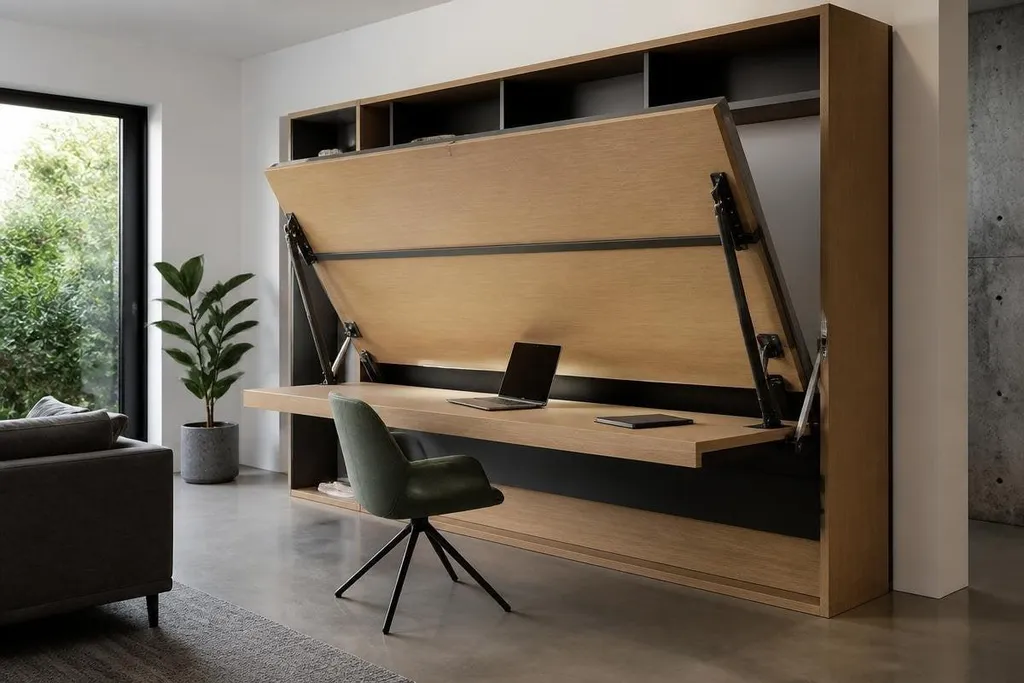
A desk that raises itself, a bed that folds into a wall, or a shelf that moves toward you can sound useful. The hard part is making that motion safe, quiet, reliable, and worth the added cost.
This article looks at how robotics could change furniture, what the hardware would need to do, and where the idea still lacks proof.
Quick read
- Motors could change height, position, or shape after a button press or sensor input.
- Safety systems matter more than the moving parts because furniture shares space with people.
- The best use cases will solve a daily space or access problem, not add motion for its own sake.
What robotic furniture would do
Robotic furniture would use motors, hinges, rails, sensors, and control software to move a part of the object. Height could change on a desk. A cabinet could bring a shelf down to hand height. A bed might fold against a wall after the room is clear.
The motion could start from a button, phone app, voice command, pressure sensor, or camera. Each method has a limit. A button needs reach. An app needs a charged device. Voice control can fail in a noisy room.
A camera can miss an object hidden behind the furniture. That makes the task more important than the feature list. Someone in a small home may need a bed that clears floor space during the day. Someone with limited reach may need storage that moves shelves down. Someone at a desk may want height changes without lifting a heavy top by hand.
The robot must also know when to stop. Force sensors can detect extra resistance, while position sensors tell the controller where the furniture is. A hand caught under a moving table is a safety problem, not a minor software fault.
The hardware behind the motion
A moving table needs enough torque to lift its top, legs, and anything sitting on it. Torque is the twisting force from the motor. The system also needs a brake or locking part so the table stays in place when power is off.
Rails and hinges carry the load through the frame. Poor alignment can make a motor work harder, wear parts, or stop halfway through a movement. The frame must handle repeated motion without loosening at the joints.
Noise matters inside a home. A motor that works well in a workshop may be unpleasant beside a bed or in a shared room. Heat, cable routing, cleaning, and access to service parts also shape the design.
A robotic sofa or table has to leave room for people to clean it and reach its service parts. Home robotics design reports can tie those needs to the robot’s layout and tested tasks before the next section looks at where the idea fails.
Where the idea can fail
Furniture has to survive daily use, moving objects, children, pets, spills, and people leaning on it. A robot made for a clean test area may face a much harder setting beside a sofa or kitchen table.
Power loss is another problem. The furniture should stop safely, hold its position, or allow manual movement. A bed that cannot fold because its motor lost power is inconvenient. A cabinet blocking an exit is far more serious.
Maintenance can raise the cost. Motors wear out. Sensors need checks. Software may need updates. If a repair needs a specialist visit, a normal piece of furniture becomes a service job.
There is also a clear design limit: movement does not equal usefulness. A chair that adjusts itself may help with posture, but only if the user can set the right position and the mechanism stays quiet. A shelf that moves every time someone walks past may create more trouble than it solves.
A buying and design checklist
Before choosing or building robotic furniture, check these points:
- Name the task: write down the daily action the movement should remove.
- Check the load: include the furniture part and anything people may place on it.
- Test power loss: confirm that the unit stops safely and permits manual recovery.
- Inspect pinch zones: look at gaps around hinges, rails, legs, and closing panels.
- Plan service: find out who replaces motors, sensors, cables, and control boards.
- Measure the room: leave space for the furniture at every point in its movement.
Without a named product, price, or test record, no firm buying case exists yet. The idea makes sense for tight rooms and access needs, but the unproven part is long-term home use.
I’d wait for products with clear safety tests, repair details, and a manual backup before paying extra for motion.
The useful measure is not how many shapes the furniture can make. It is how many safe, quiet movements it can complete before the first repair.